
In this article:
- Stage 1: Random Acts of Revenue
- Stage 2: Checkbox Go-to-Market
- Stage 3: Self-Reinforcing GTM Engine
- The three stages, summarized
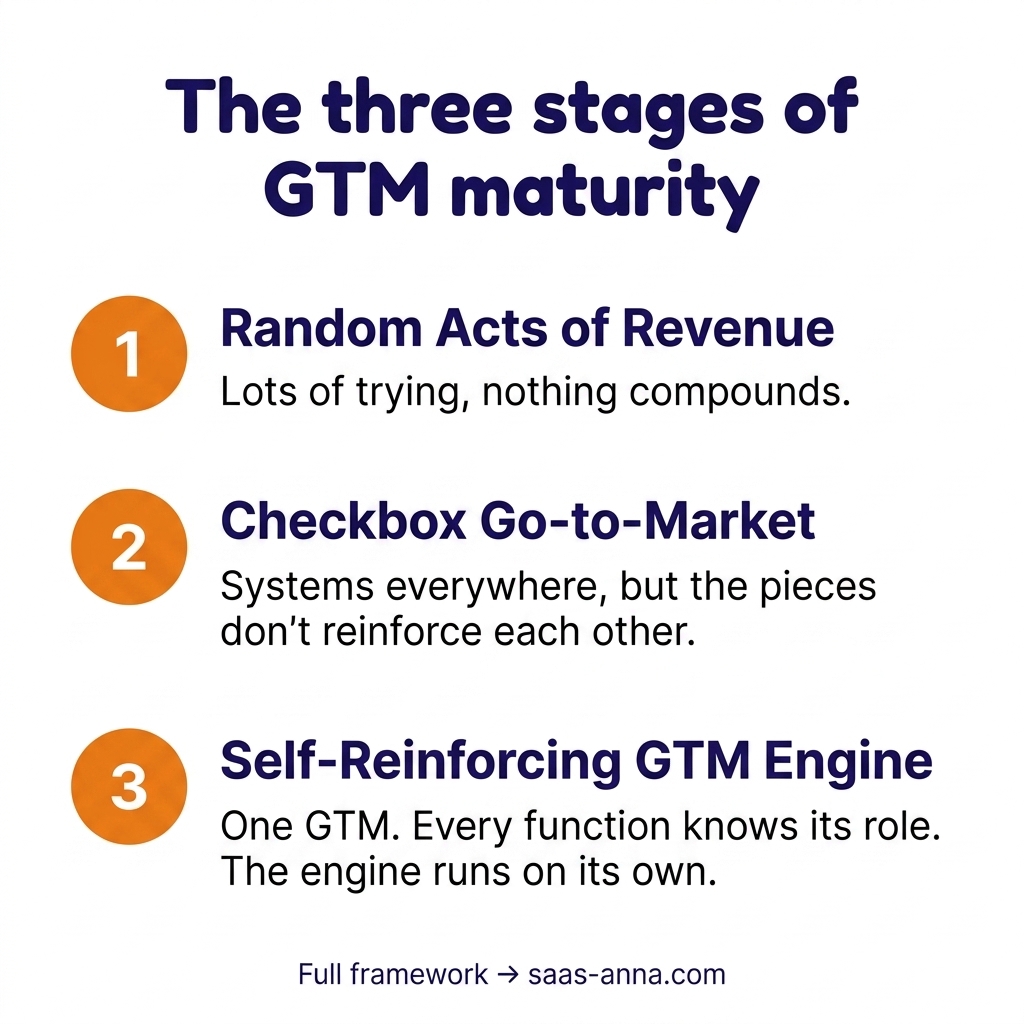
Between random acts of revenue and a self-reinforcing GTM engine, most B2B SaaS companies sit in one of three stages:
- Stage 1 — Random Acts of Revenue: lots of trying, nothing compounds
- Stage 2 — Checkbox Go-to-Market: systems and routines everywhere, but the pieces don’t reinforce each other
- Stage 3 — Self-Reinforcing GTM Engine: one GTM where every function knows its role and the engine runs on its own
Here’s what each one looks like.
Stage 1: Random Acts of Revenue
“Let’s try a LinkedIn campaign. Let’s try this outbound messaging. Let’s do a webinar. Let’s focus on target audience X. Let’s expand to DACH.”
You’re doing a lot of things. You jump from one channel, tactic, or focus area to another every month. Eventually you feel like you’ve tried everything and nothing “just seems to be working for us.”
What’s happening underneath:
- Ideas come and go randomly, with no systematic feedback loops for learning
- Whoever is most vocal or has the strongest opinions wins
- Initiatives are one-off, with no connection to the bigger picture or to each other
- No reinforcing loops, no compounding effects
- Even when campaigns are “always-on,” they’re shallow — not based on any real decisions or tradeoffs
If this feels familiar, the instinct is to look for better channels. That’s usually the wrong move — your channels aren’t the problem, your GTM model is.
Stage 2: Checkbox Go-to-Market
You now have systems and routines in place. It’s not ad hoc anymore, which gives many people peace of mind:
- A marketing plan
- Monthly webinars
- A well-documented sales playbook
- Maybe complex agentic outbound sequences with waterfall enrichment
- Multiple value props being tested at scale
On the surface, everything looks good.
The plan itself came from a real need: it feels systematic, and it gives you focus on a daily basis — a relief from jumping from one thing to another. But focus isn’t the same as impact. The real problem:
- You can’t actually prove the impact of most of your work
- It’s brilliant execution without strategy — systematic and high-quality, maybe, but in isolation, without an overall GTM engine to lead it
- You’re doing things because they’re on the plan and make you seem like you have a system — not because they drive results
- Very few initiatives compound or build on each other: it’s still just another monthly webinar after the previous one, perhaps repurposed into a random blog post and posted to LinkedIn once
- You might repurpose, you might redistribute — it feels systematic, but it’s not really compounding
This can work for a while, but when it eventually stops working, you’re left wondering: “We have all these systems, why aren’t we getting results?”
Stage 3: Self-Reinforcing GTM Engine
Stage 3 is about having one go-to-market — not different channels and functions doing random things by themselves. Everybody knows their role in the engine.
You started with your PMF basics:
- Who you’re building for
- What problem you’re solving for them
- Why you can solve it better than other solutions
- Why they care about solving this problem
You took all this into account in your GTM: product, offer, pricing, operations, packaging, positioning, messaging, and distribution.
When you build your GTM engine, you start with your specific GTM conditions and everything reinforces everything else. Your channels and tactics compound. Your goals and GTM blockers determine your plays:
- If you need to build trust first before getting to sell, you won’t start with “book a demo” push ads
- If you do PR, it’s not a one-off pitch but an ongoing thought leadership play that feeds your SEO
- When you repurpose content and ideas, you’re not doing it because “we have to post 3x per week” — you’re doing it because you want to reach your audience across specific channels to get to a specific goal
And each function’s role comes from the kind of GTM engine you’re running. Take marketing, for example:
- In a partner-led GTM, marketing probably isn’t generating leads — it’s supporting the partner channel with product marketing and sales enablement.
- In a sales-led GTM, marketing is feeding the pipeline and arming sales — demand gen, ABM, and content that helps sales close deals.
- In a marketing-led GTM, marketing is actually producing direct leads — owning content, SEO, paid acquisition, and the conversion paths from awareness to demo.
- In a product-led GTM, marketing is embedded into everything you do — from viral acquisition loops to user communities and activation content.
You’ve built an always-on GTM engine that feeds itself — not a series of disconnected campaigns.
The three stages, summarized
| Stage 1: Random Acts | Stage 2: Checkbox | Stage 3: Engine | |
|---|---|---|---|
| How decisions get made | Whoever is most vocal wins | The plan is the decision — you build it because it feels systematic | The engine model sets each function’s plays |
| Whether initiatives compound | Do something, forget it. Do the next thing, forget it. | Repurpose, redistribute — feels systematic, but isn’t really compounding | Everything reinforces everything else |
| What the rhythm is | One-off initiatives | Monthly cadence on the plan | Always-on engine |
| What the overall GTM looks like | Scattered tactics — no overall GTM | Systematic execution, but in isolation | One GTM — not a series of disconnected campaigns |
Getting from Stage 1 to Stage 3 isn’t about doing more. It’s about making sure what you already do connects into one engine — and that’s the work a fractional GTM lead takes on. Increasingly, that engine includes a codified GTM context layer for the AI tools that ride on top — so the team’s judgment compounds rather than getting re-derived every quarter.

Anna Ursin
Fractional GTM lead for B2B SaaS companies at €1M–10M ARR. I help founders build go-to-market engines that actually connect to pipeline — instead of random acts of marketing. More about me
