
When sub-5M ARR companies try to scale, one of three things is usually happening:
- You’re scrambling. Testing channel after channel, pausing ads, starting outbound, trying GEO. The last thing didn’t clearly work, so you reach for the next. Clearly, what you need is a more systematic approach to channels — right?
- You’re living off “accidental inbound.” Unattributable word of mouth, a trickle of referrals, occasional organic traffic. You can’t say where any of it came from. You’d like to make it more systematic.
- You’re running campaigns and getting some leads (congrats). The logical next step feels like scaling the channels, hiring in-house, or finding a specialist agency. Too bad: the leads often come regardless of your channel efforts, not because of them.
Either way, you’re likely working on the wrong layer.
Most founders who end up on a call with me arrive with channel questions. What channels should we be on? Should we do LinkedIn thought leadership ads? Is GEO the next SEO? Can you build us an outbound engine with Claude Code?
Almost every time, the question is meaningless — at least until you’ve figured out how the channel fits the rest of the GTM engine.
In this article:
What is a channel, anyway?
A clean-up first. The word “channel” gets used so loosely it’s part of why this mistake keeps happening.
A channel is a distribution mechanism.
Channels can be push (outbound, ads) or pull (SEO, word of mouth, virality). They can be owned (your email list or social following), paid (ads, newsletter sponsorships), earned (PR), or borrowed (a partner’s audience, a backlink). What they have in common is that they’re all ways to reach people.
These are channels:
- SEO, GEO, Backlinks
- PR
- Organic social
- Social ads (LinkedIn, Meta, Reddit)
- Outbound outreach (email, calling, LinkedIn)
- Search ads
- Attending events or tradeshows
- Partner or reseller distribution
- Embedding into ecosystems
- Viral loops
- Word of mouth
These are not channels:
- Events and webinars (distributed via LinkedIn ads, email)
- Blog posts (via SEO, organic social, LLMs, dark social)
- Website (via Google search when people look for your brand)
- Podcasts (via Spotify, YouTube)
- Infographics (via organic social)
- Case studies (via salespeople sharing them with prospects)
These are content formats and conversion points. They need a channel to reach anyone.
A few things — like communities, email lists — look like channels but have a catch. You need another channel to get people into them first (direct outreach, referrals, SEO) before you can reach them at all.
TL;DR: if your “channel strategy” starts with “we’ll do a webinar series” or “a blog series,” you’ve conflated the two. The webinar is what you make. The channel is how it travels.
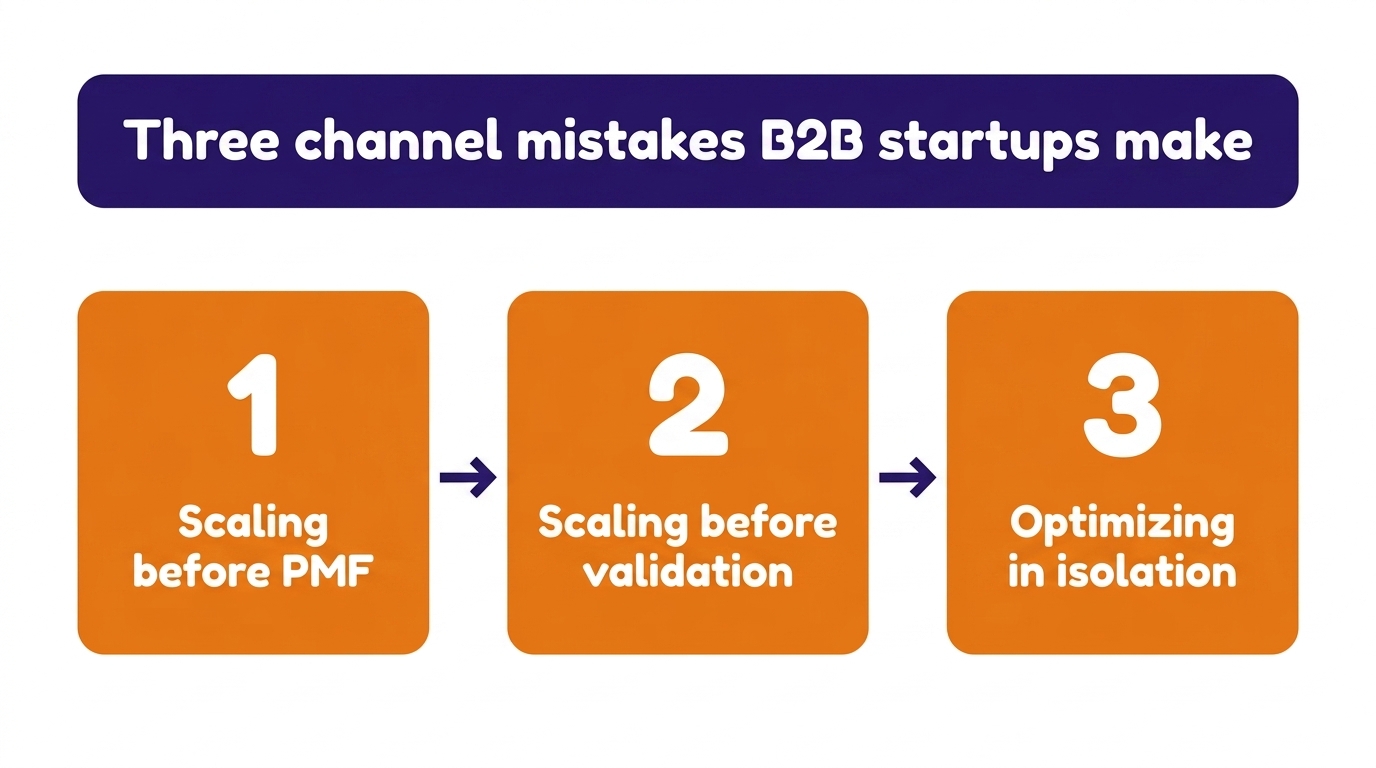
Three channel mistakes B2B startups make
Here are the three traps I see most often. They all share a root cause: treating a channel as if it’s the growth mechanism, when the growth mechanism lives upstream.
Trap 1: Scaling a channel before you have PMF
Everyone can build now, so distribution is often the differentiator. Which is exactly why it’s tempting to chase something concrete — scaling a channel — before you have a scalable business (PMF, validated ICP, etc.) underneath.
Distribution definitely matters at this stage — just not the way most founders think.
You can’t bolt channels onto an un-validated business. If your product is embeddable — ecosystems, partners, viral loops — start building that now.
But if not (for most of us), focus on the non-scalable work first: founder-led selling, customer conversations, validating the ICP. Only then layer on scalable channels.
Trap 2: Scaling before validating channel potential
Even with PMF in place, you’re still early in validating your go-to-market fit.
When a channel “works” in a scrappy phase, it’s sometimes because other touches are silently doing half the work: founder brand, community reputation, organic inbound, word of mouth. What you could measure was riding on things you couldn’t. This doesn’t mean that the channel is scalable.
When you try to scale the measurable piece, you lose the invisible ones like founder visibility. The silent multipliers disappear, and now you’re asking an unvalidated channel to carry the whole load.
Trap 3: Optimizing channels in isolation
This is the horizontal version of Trap 2. You have PMF, but what you don’t have is an understanding of how channels work together as one engine.
In very few cases does one channel carry its weight alone. Some companies grow off ecosystems or viral loops, but most of us have to stack channels — each playing a role in a sequence and reinforcing each other.
Ads are the classic silver-bullet example. A buyer sees your ad once a month. They don’t understand what your product does. They probably aren’t the right fit. How is that ad supposed to produce a direct lead?
It can’t — and no amount of optimization changes that.
Instead, LinkedIn ads often work best as ABM air cover, or as an extra touch in the buyer journey to stay top of mind. Not always as a direct converter. Channels don’t work in isolation. A lead who closes touched five (or fifteen!) things first: a founder’s LinkedIn post, a podcast mention, a peer referral, a few product marketing ads, an outbound email, event sponsorship, then an ad again. The last ad didn’t convert them — the sequence did.
The bottom line
Channels only amplify what exists. They don’t create PMF, GTM fit, or clear positioning.
None of this means don’t run channels. Run them — but know when to scale. Not before you have PMF, not before you have validated channel potential, and not before you know its role in your overall GTM.
But “what channels should we be on?” question is almost never the question founders should be asking when looking to scale their company.

Anna Ursin
Fractional GTM lead for B2B SaaS companies at €1M–10M ARR. I help founders build go-to-market engines that actually connect to pipeline — instead of random acts of marketing. More about me
