
In this article:
- Six months in — and still no results
- Why the agency didn’t catch it
- Why switching agencies won’t help
- Where to look first
Imagine you’re a B2B SaaS founder. Let’s say you sell customer onboarding software. You’ve been running Google Ads for 6 months. The agency you hired is reputable. The campaigns look clean.
But there’s one problem: you’re not getting results.
And you’re struggling to understand why.
You’re probably tempted to switch agencies. Trying to understand why it isn’t working. Did the agency lie? Are they not as good as they said they would be? Is it the copy? Is it the campaign set up? Is it the fact that we’re not using all the newest bells and whistles? The latest Google algorithm update?
But the real reason is none of those.
Six months in — and still no results
6 months, €10K spend, 20 conversions (and only 5 of them non-brand).
When you look closer, you find something interesting:
Half the keywords the agency is bidding on (“onboarding software,” “employee onboarding,” “user onboarding”) are in completely different categories from your actual product. “Employee onboarding” pulls in HR systems — BambooHR, Rippling, Workday — built for new hires. “User onboarding” pulls in in-product/PLG tools — Pendo, Appcues, Userpilot — built for SaaS users adopting features inside an app. Different buyers, different products entirely.
The keywords closer to your real intent — anything more vertical-specific — are contaminated too. About half the SERP results are enterprise platforms aimed at much larger customers, with deal sizes 100x what you target. Same words, different product.
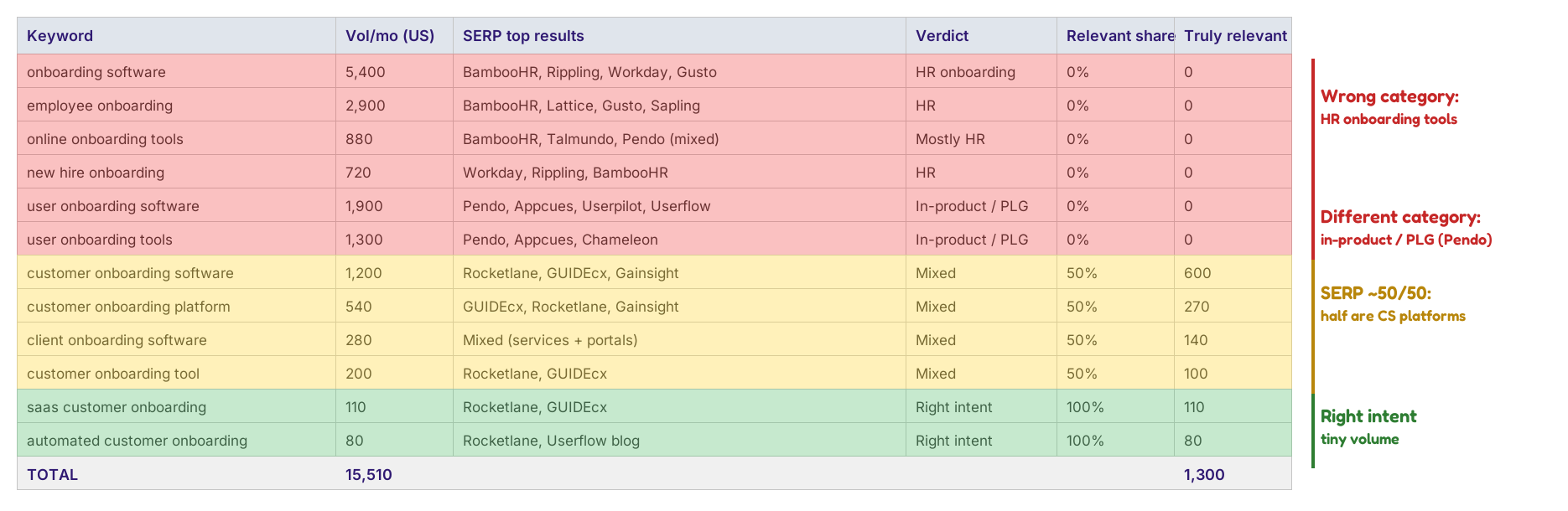
92% wrong intent. Numbers are illustrative; the real client’s audit landed almost exactly here. Click image to enlarge.
When you finally start looking into the details, you find something interesting.
This time, the unit economics aren’t the problem (that’s the first thing I always check).
But turns out the actual addressable market for this channel is just ~1,000 relevant searches per month. Run the math at standard B2B SaaS benchmarks:
- 1,000 searches × 50% impression share = ~500 impressions/month
- × 3.2% CTR = ~16 clicks/month
- × 1.4% landing-page conversion rate = ~0.22 demos/month → one demo every 4–5 months
- × 20% win rate = ~0.04 customers/month → roughly two years to one customer
The problem is that the clicks don’t exist to buy.
So in this case, Google Ads simply isn’t a growth channel for the specific product category, since the demand doesn’t really exist yet. You can’t capture something that doesn’t exist in the market. If anything, it’s a safety net at best.
Why the agency didn’t catch it
Your agency isn’t doing bad work. They’re optimizing Google Ads — tightening bids, structuring campaigns, keeping the account technically clean. What they don’t do is step outside their channel and say “Google Ads isn’t the right fit for this product.”
They can’t. Nobody on your side has ever defined what role Google Ads is supposed to play, who your ICP actually is and what are your sweet spot use cases.
There’s a budget and a brief: run Google Ads. So they run Google Ads, and they focus on optimising the heck out of it and try to find optimisation hacks at the tactical level because they know nothing better.
Why switching agencies won’t help
This story isn’t hypothetical. It’s a real client of mine. The product isn’t actually customer onboarding software, but the intent mismatch and the agency dynamic — all of it is real. And it’s not a unique case: the same problem applies to almost every single B2B SaaS company I work with, in one way or another, regardless of the channel.
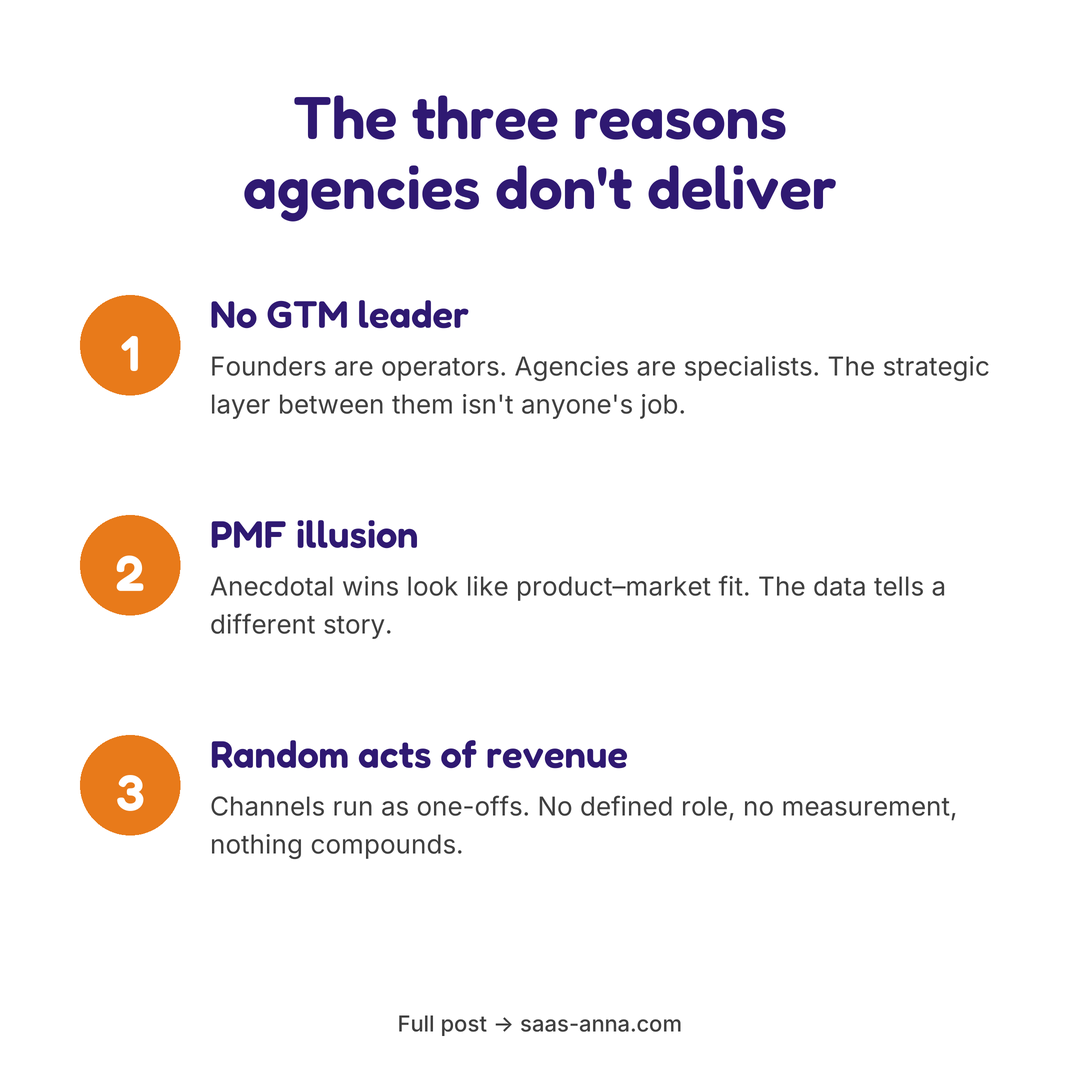
1. The go-to-market leadership simply isn’t there
Most small company founders are primarily operators and subject matter experts, sometimes generalists – not marketing or sales leaders.
They’ve done some go-to-market in their lives – they are founders after all. They might even know one tactical area well — one of them is decent at SEO, another has run outbound at a previous company, a third has a gut feel for content — but for the most part, they’re not go-to-market experts.
Agencies, on the other hand, are specialists. They operate on a channel level. There’s real value in channel specialists, and the best agencies do excellent work. But even the best generalist agencies are still specialists when it comes to your business. They simply don’t have the business context that your best freelancers, in-house marketers, or fractionals can have.
The problem is the combination: when you don’t have go-to-market leadership and when you don’t have operators who have the whole context and the judgement to make strategic calls. The whole value chain collapses.
2. You don’t have the product-market fit you think you have
Founders believe they have PMF based on a handful of anecdotal wins, but the data tells a different story — they haven’t sold the same use case to the same customer segment repeatedly and predictably. So how are you supposed to tell an agency who you’re for and what you do?
3. You’re doing random acts of revenue, not building a GTM engine
Even if you do have real PMF, you may not have a GTM engine. Most companies are just running random acts of revenue.
In other words, you don’t know what role each channel is supposed to play. Even when a channel could be a fit, the role matters. Is it a growth channel? An awareness channel? A safety net? A reactivation channel?
Most companies have never asked.
They run Google Ads when their unit economics can’t absorb the CPAs. They run direct-response LinkedIn ads with a €20k ACV B2B product and expect conversion from the second ad anyone has ever seen from them. They start a podcast because top-of-funnel feels important.
Sometimes those things work. Sometimes they don’t. Either way, nobody learns much, because nobody defined what the channel was supposed to do in the first place.
A good specialist can be deeply strategic inside their craft — including telling you when their channel doesn’t fit, or that the role you’ve assigned it is wrong. But they can only do that if you’ve given them something to fit to.
Where to look first
I’ve seen really good agencies fail. When they do, it’s almost never because they couldn’t execute. It’s because they were never given the guidance to. And that happens for one of three reasons.
If your agency isn’t delivering, the first place to look isn’t their work. It’s one of those reasons — and switching agencies won’t fix either.
What’s missing is the explicit decision about what role each channel plays in your GTM engine, and the bet you’re making by including it.
For more on what that looks like in practice, see Three stages of GTM maturity.

Anna Ursin
Fractional GTM lead for B2B SaaS companies at €1M–10M ARR. I help founders build go-to-market engines that actually connect to pipeline — instead of random acts of marketing. More about me
